-
 NewsUmbria: innovation in early warning systems
Umbria: innovation in early warning systems
March 2026
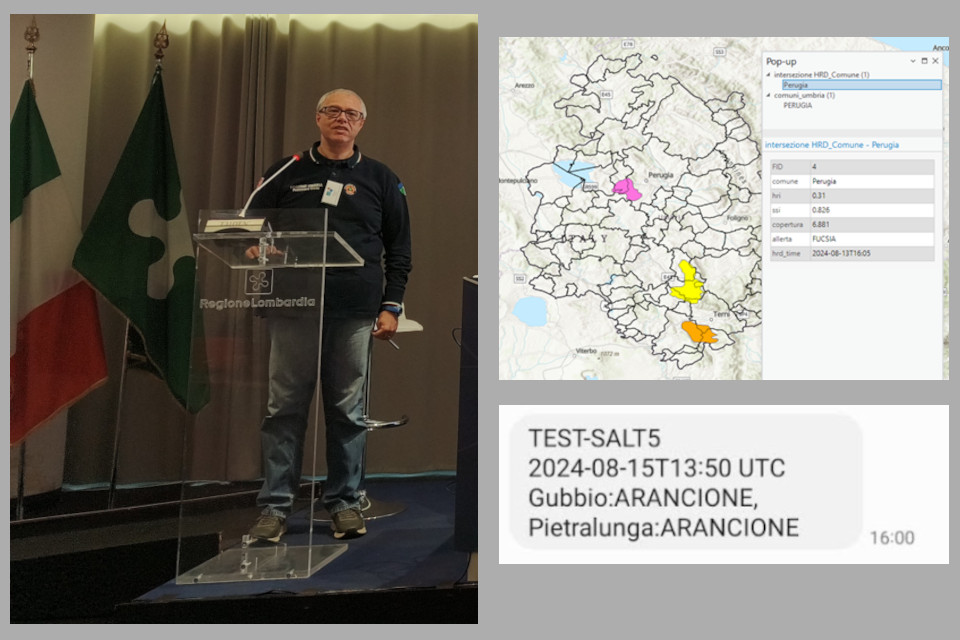
For several years now, the Functional Center of the Umbria Region, located in Foligno, has adopted Sentry, CAE’s new alert message dissemination software. This product stands out for its modular structure, which allows for the seamless addition of a wide variety of communication channels for sending alerts, with a strong focus on achieving maximum interoperability. Sentry is database-independent software and interfaces with standard systems through the CAP protocol, enabling the dissemination of alerts even from non-CAE systems that communicate using this standard protocol. The flexibility of the product has allowed the Umbria Region to create a CAP system also based on radar products.
Therefore, the Functional Center has independently developed a new automatic alert system called SALT: Sistema Allarme Temporali, presented during the national radar meteorology conference RadMEt2025, held in Milan at Palazzo Lombardia, the headquarters of regional offices, sponsored, among others, by CAE.
Our editorial team spoke with Renato Zauri, meteorologist at the Functional Center of the Umbria Region, to find out more.
What does the SALT system consist of?
In brief, it is an automatic alert system that notifies the operator or on-call personnel of the Functional Center of the Umbria Region of the presence of precipitation over the regional territory, mainly of a thunderstorm nature.
The detection of the phenomenon is carried out using the RADAR HRD (Heavy Rain Detection) product, developed by the National Department of Civil Protection and made available in real time to the network of Functional Centers.
A GIS-based geostatistical algorithm calculates the intersections between the polygon generated by the HRD algorithm and the boundaries of municipalities in Umbria, identifying those affected by the thunderstorm event.
The intensity of the phenomenon is represented by a color scale ranging from yellow to purple, passing through orange, red, and fuchsia. This color coding is crucial for the subsequent actions of the Functional Center operator in assessing whether to contact the affected municipality.
Once the involved municipalities and their associated color codes are identified, a message in CAP format is generated and sent to Sentry via API for subsequent dissemination via SMS and voice calls to a set of operators and on-call personnel.
What role did Sentry play in its development?
A fundamental role. First of all, its ability to process XML CAP messages generated from any source and the possibility of sending them directly to the system via API.
It was also possible to configure contact lists and dissemination profiles in detail, differentiating users who receive only SMS messages from those who also receive voice calls.
Furthermore, the entire SALT system was deployed within the CAE cluster at the Umbria Functional Center, making it highly robust within a mission-critical platform.
What results have been achieved so far thanks to SALT, and what are the challenges for the future?
It is important to highlight (and this is also the reason that led us to develop it) that SALT is not a nowcasting system, nor a mass alert system, nor a preventive alert system. Rather, it is a support tool for the operator/on-call staff of the Umbria Functional Center in monitoring intense precipitation, especially for sudden and hard-to-predict events.
A decision-making process, based on empirically constructed tables, enables the operator to assess the phenomenon and contact the local administrations affected, partially reducing the margin of discretion.
The most significant outcome of this monitoring process is the general appreciation from most of the local administrations contacted during events, as well as the activation of a virtuous cycle of communication and feedback among the various actors of Civil Protection.
We thank Renato Zauri for the time he dedicated to us, confident that we have presented an interesting example of the application and use of technologies designed to be open, customizable, and autonomously managed by the users themselves.
The Editorial Team of CAE Magazine
Back to the index